What the dancers wear
Croatian folk costume, region by region
How Croatian folk costume changes from region to region, what the Dubrovnik style looks like and where the Konavle embroidery fits.
Reserve a seat for the show ↗One country, many costumes
There is no single Croatian costume. Wikipedia explains that each cultural and geographical region has its own variety of dress, differing in style, material, colour, shape and form, and that foreign rule left its mark: Austrian, Hungarian, German, Italian or Ottoman influence, depending on who governed a region. Today people wear Western clothes day to day, so national costumes appear at festivals, weddings, religious holidays and in dance groups. That is why a folk ensemble can show Croatia through cloth.
Broad styles
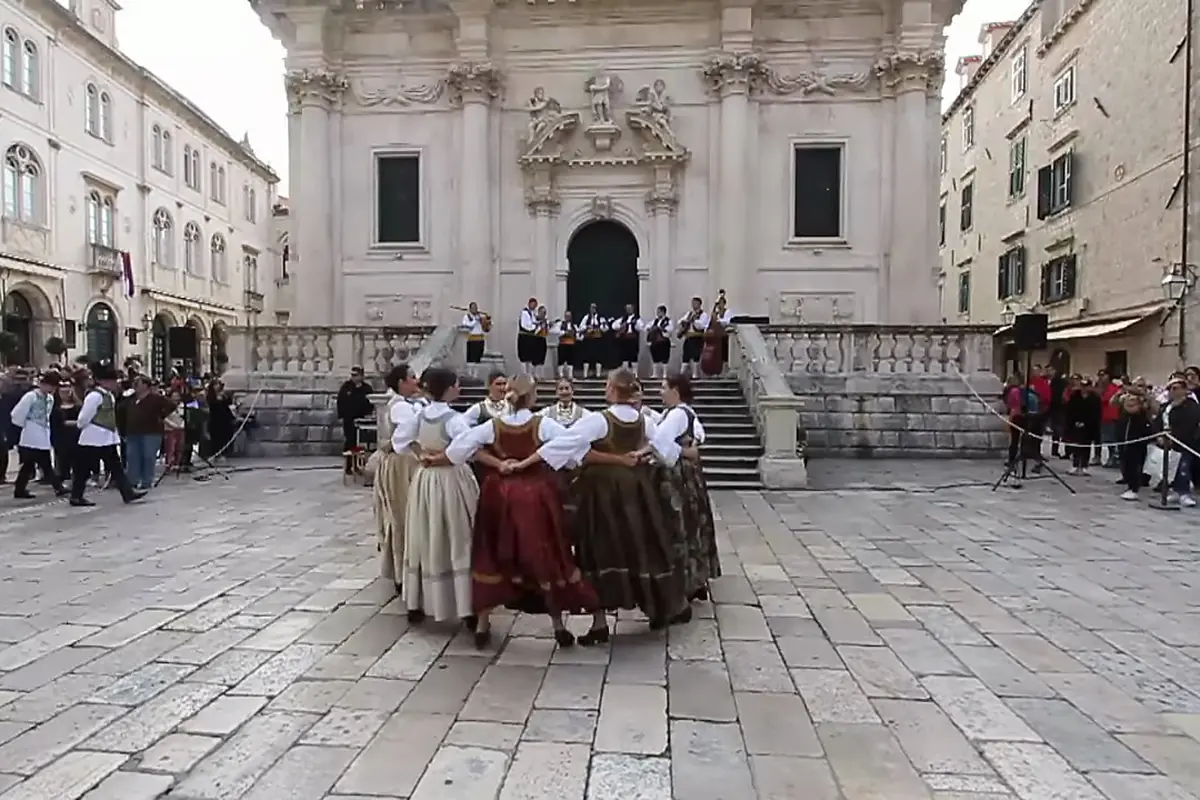
Wikipedia groups regional dress into broad styles: the Pannonian style in the north and east, the continental or Dinaric style, and the coastal style, with the islands varying most of all. The coastal style is the one nearest Dubrovnik. Broadly, a woman's costume starts from a white blouse or dress, then adds layers such as an overdress, apron, jacket and scarf, with embroidery in red, white, blue, gold or black. A man usually wears a shirt, trousers, a vest and a cap that varies by region.
The Dubrovnik style
According to Wikipedia, the costume of Dubrovnik consists mainly of white, black, gold and red. Both men and women wear vests rich with gold embroidery, and the women wear recognisable gold tassels decorating the front of the blouse, along with fine jewellery such as earrings, necklaces and hair clips. Men and women usually wear white or black trousers or skirts. At a performance, look for that palette in the dancers' costumes, where gold thread catches the light.
Konavle embroidery
South-east of Dubrovnik lies Konavle, whose silk embroidery is protected cultural heritage of Croatia. A European Heritage Days entry describes girls who raised silkworms and produced and dyed their own silk threads, and says the embroidery was once the only decoration on women's costume, concentrated on tiny silk sleeves and chest pieces rather than the whole garment. Tassels, patterns that commemorate a death in the family and black dyeing for mourning are all part of the tradition, which reads costume as a record of a woman's life.
Contrasts elsewhere
Travel a short way and the picture changes. Slavonia's costumes tend to be very elaborate, with floral designs, fine embroidery and silk ribbons. Lika's costumes show Dinaric and Ottoman influence, with wool dyed in red, black, yellow and green. On the island of Pag, a fifteenth-century costume tradition is known for its lace and the large white headdresses of women. These contrasts are why a folk ensemble's programme can feel like a tour of the country: the dress changes as the region changes.
Read next: Linđo: the Dubrovnik dance
Men's dress and women's jewellery
A man's costume usually consists of loose, wide trousers and a shirt, often black or white, with a decorative or plain vest and almost always a cap whose shape depends on the region. Women's jewellery runs from necklaces, earrings, bracelets and rings in gold or silver to beads, pearls and even coral from the Adriatic. Wikipedia notes that hair is braided and decorated with red ribbons for unmarried girls, while married women wear woven or silk kerchiefs, so a costume can signal more than a place.
Why costumes matter in dance
Costumes are most often worn at ethnic festivals, religious holidays, weddings and by dance groups performing the kolo, the circle dance. For a dance group, the cloth is part of the movement: skirts swing, sleeves flare and fringes catch the light as the circle turns. That is the reason a Dubrovnik folklore show feels so visual, and why many visitors remember the costumes first. Notice how the dancers' clothing changes the shape of the circle when they turn together.
Read next: Dubrovnik folklore show tickets
What to look for on stage
In the show, look at the layers first: white blouses and the contrast of dark skirts, then the vests and the metal glint of gold thread. Look at hats on the men and headwear on the women, since both vary by region. Notice whether the costumes in a number match one another or change between numbers, which would signal a move from one region to another. The programme is the ensemble's choice, so treat these points as a lens, not a checklist.
Sources