The dance behind the name
Linđo: the Dubrovnik dance
What the linđo is, how a dance master and a three-string lijerica drive it, and how a village circle dance became a stage piece.
Reserve a seat for the show ↗A dance of the Dubrovnik coast
The linđo is a popular dance of Dubrovnik and the region around it. Wikipedia says it is now performed along Dubrovnik's coast, in Konavle, in Dubrovačko Primorje, on the Pelješac peninsula, on the islands of Mljet and Lastovo, and in parts of Herzegovina. That spread explains why a visitor to Dubrovnik meets it as the city's own dance: it belongs to a strip of coast and islands, not to one square. Wikipedia's survey of Croatian dance calls it a popular dance of Dubrovnik and southern Dalmatia, with a distinct Mediterranean influence.
The lijerica sets the beat
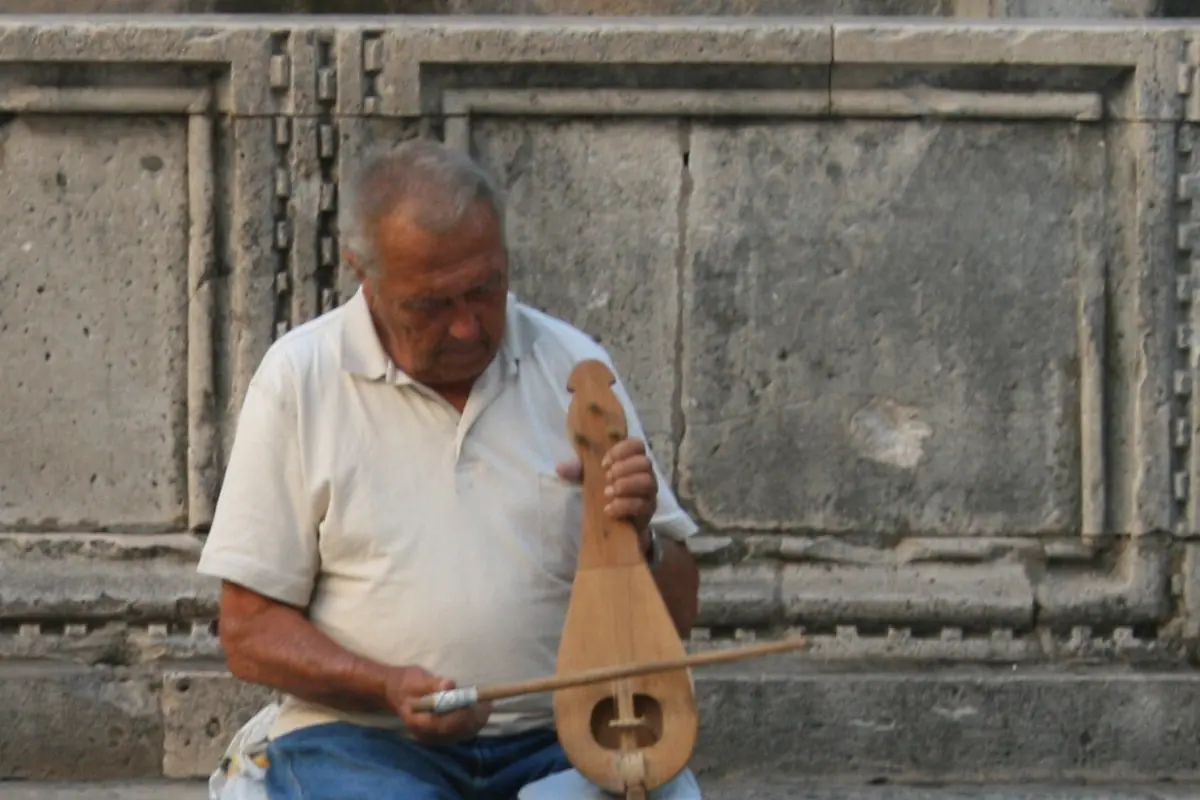
The linđo is danced to the lijerica, a pear-shaped, three-stringed instrument played with a bow. Wikipedia says it arrived from the Eastern Mediterranean in the late eighteenth century and spread along the Adriatic coast in the nineteenth. Its name comes from the lyra, the bowed instrument of the Byzantine Empire, from which it probably evolved. The same article records that, in the past, the dance was performed only to the accompaniment of bellows, so the lijerica is a later partner rather than the original voice.
The dance master gives the orders
In the traditional form, the dance master sits with the lijerica on his left knee and stamps with his right foot, which dictates the rhythm. The dancers move in a circle around him. He gives commands in rhyme, humorous and often with a double meaning, and he decides who dances with whom and when the figures change. He also encourages the dancers to compete in improvisation. The result is a dance with a conversation inside it, in which wit counts as much as footwork.
The man behind the name
Wikipedia traces the dance's name to a one-time legendary dance leader, Nikola Lale, known as Linđo, from Župa Dubrovačka. His descendants still live in Župa Dubrovačka. The Dubrovnik ensemble that performs the show took its name from the dance, which is why you will see Linđo on a poster and a dance in the programme under one word. The name therefore points to a person, a dance and a company at once.
From village circle to stage
The ethnologist Elsie Ivancich Dunin has studied dance in the Dubrovnik area through the lens of tourism. She describes the later introduction of an authored, staged version of the Primorje dance linđo into a city amateur ensemble established in 1965. What you watch in a theatre, then, is a choreographed form, shaped for an audience, not a record of a village evening. That does not make it less worthwhile. It means the structure, the costumes and the timing are deliberate, and the ensemble keeps the tradition alive in a form visitors can see.
Folklore and tourism
Dunin's article, which covers the years 1948, 1977 and 2008, looks at how village dance in the Dubrovnik area became part of the tourist offer, a commodity shaped for visitors. That history matters for what you watch. The dances that reach a stage have passed through decisions about length, costume and order, and the ensemble keeps the tradition of the linđo alive in a form a visitor can follow in an evening. Treat the show as a living adaptation, valued for the care taken with it, rather than as a lost village night.
Read next: Dubrovnik folklore show tickets
Where the linđo sits among Croatian dances
The kolo is the South Slavic circle dance, found in Croatia, Bosnia and Herzegovina and Serbia, and each region has its own variants. In Dalmatia, the linđo stands beside the nijemo kolo, a silent circle dance of the Dalmatian hinterland that UNESCO inscribed in 2011, danced entirely without music. Wikipedia's list of Dalmatian dances also names the potkolo, a line dance done to the tamburica, and the poskočica, a couples dance done to the lijerica. Seen together, they show how a small stretch of coast holds several distinct traditions, each with its own sound and step.
Read next: Croatian folk costume, region by region
What to watch for
The programme is the ensemble's choice on the night, so a full linđo with a lijerica may or may not appear. If it does, look for the circle, the rhythm of the stamping foot and any change of partners. Listen for the lijerica's bowed tone, which differs from a tamburica's plucked sound. And watch for the humour: the traditional commands are in rhyme and meant to be funny, even when you cannot follow the words. If the linđo does not appear, the show still offers other dances from Croatia's regions, and the guides here explain the main forms.
Sources